

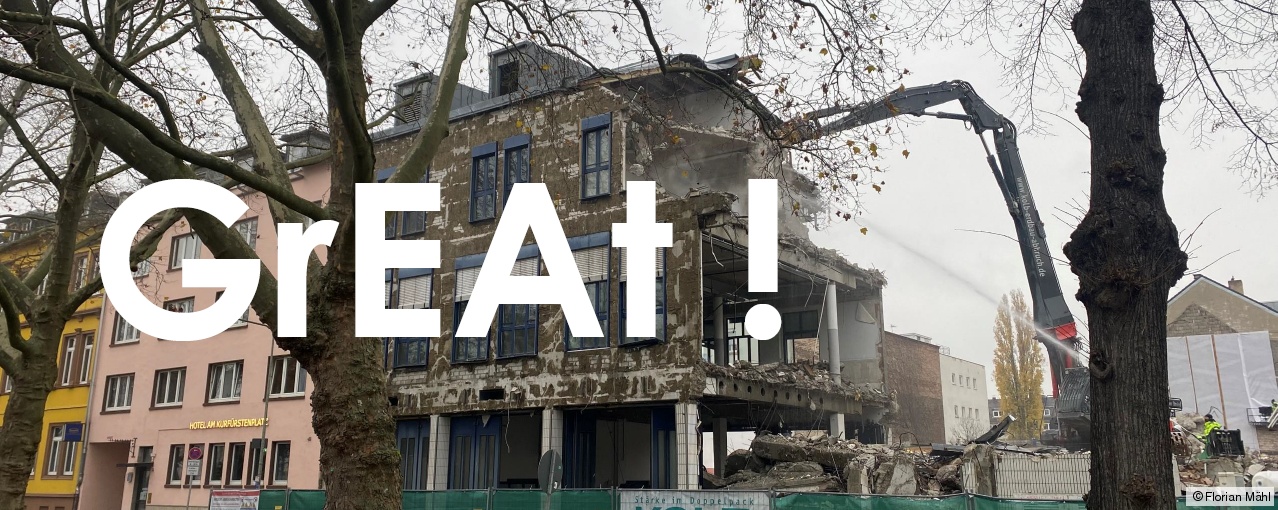
Assess building durability in a transparent manner
The Grey Energy Atlas (GrEAt!) is a research and teaching project aimed at systematically documenting and evaluating the material-ecological quality of existing buildings. The focus is on post-war modernist buildings in the Frankfurt/Rhine-Main region and in Ghent (Belgium), which are analyzed in terms of their embodied energy and associated greenhouse gas emissions. These metrics describe the environmental impacts of the building stock throughout its entire life cycle—from construction to the present day—and enable an assessment of its ecological value.
The project’s goal is to develop comparable assessment criteria that can be used both for planning renovations and for strategic decisions regarding existing buildings. By presenting the results visually, complex relationships are made understandable, creating a solid foundation for sustainable building decisions.
The project thus makes an important contribution to resource-efficient urban redevelopment by strengthening the preservation and further development of existing buildings as a central strategy for addressing the climate and energy crisis. At the same time, GrEAt! serves as an innovative teaching and research format that introduces students to the challenges of sustainable architecture in a practical way and facilitates exchange among students from the U!REKA European University Network.
Assessment, Visualization, and Sustainable Use of Existing Buildings in the Context of the Climate and Resource Transition
- Systematic analysis of existing buildings as “test cases” to identify patterns and benchmarks
- Development of standardized metrics that can be applied early in the renovation planning process
- Focus on preservation rather than demolition: Existing building stock is viewed as a valuable resource with “stored” energy
- Use of visualizations and scenarios to make abstract environmental metrics understandable to decision-makers
- Interdisciplinary and international research and teaching approach in collaboration with universities, including within the U!REKA European University Network
Buildings surveyed
- "Juridicum" at the campus Bockenheim in Frankfurt am Main
- Building 8 at the Frankfurt University of Applied Sciences
- Building 9 at the Frankfurt University of Applied Sciences
- Building 2 at the Frankfurt University of Applied Sciences
- GrEAt! goes U!REKA: Building B, Campus Schoorsmeersen der Hogeschool Gent
- NEFF-Highrise in Frankfurt am Main
- Biology Institut in Frankfurt am Main
Teaching and Research Project at Department 1
Project Leader: Prof. Dr.-Ing. Florian Mähl
U!REKA Cooperation Partners at Hogeschool Ghent (Belgium): Bjorn De Rouck, Bart D’ Herde
Coordination and Support: Ruth Schlögl, Research Officer at FFin, and Dipl.-Ing. Architect Kay Saßmannshausen, Lecturer in Structural Engineering
The following students from Frankfurt University and Hogeschool Ghent contributed to the development of the Grey Energy Atlas (in alphabetical order):
Alina Grau, Ali Malik Caliskan, Brando Alabodi, Christian Straty, Diana Berdi, Elian Vancauwenberghe, Emma Aguilar Dorbritz, Eva Hoffmann, Fanziska Rudersdorf, Jelco Depessemier, Jonas Luther, Joram Vercammen, Katharina Wicher, Klaus Böcking, Lara Zosel, Luca Duquesne, Mariem el Amri, Mario Mangold, Matheus Lybaert, Maxime van der Stappen, Pascal Reddel, Ruben de Smedt, Samuel Gemeinder, Sarah Segieth, Simon Kraut, Tim-Noah Sachs.
Duration: September 2024 – February 2026
Funding from May 2024 to March 2025: BüroN, Frankfurt University of Applied Sciences
Data collection, analysis, and evaluation of the buildings were conducted in part during courses in the Master’s program in Architecture at Frankfurt University of Applied Sciences, as well as in a workshop within the Bachelor’s program “Real Estate and Land Surveying” at Hogeschool Ghent. Starting in 2025, the project was carried out in collaboration with Hogeschool Ghent as part of the U!REKA European University – Urba
Starting in 2025, the project was expanded in collaboration with Ghent University College as part of the U!REKA European University – Urban Research and Education Knowledge Alliance.
Publication:
Florian Mähl: GrEAt! Grey Energy Atlas – Building stock as a material resource
Frankfurt, 2026 https://doi.org/10.48718/b0tp-vt87
Contact:
Prof. Dr-Ing. Florian Mähl
Professur für Tragwerklehre, Baukonstruktion und Bauphysik
Gebäude 1, Raum 509
Tel. : +49 69 1533-2752
florian.maehl(at)fra-uas.de