
Every semester, Faculty 4: Social Work and Health organizes an International Week (IW) to integrate international perspectives into teaching and thus promote the university wide iniative of "Internationalization at home". Another goal of the IWs is to strengthen exchange between students, teachers and international partners of the faculty.
Next International Week coming up in May

Faculty 4: Social Work and Health is organizing its 30th International Week (IW) from May 13-17th, 2024. The IWs have been held almost every semester by the faculty for 15 years, which form a strong tradition of supporting internationality in teaching and strengthening international exchange and partnerships over the years. This International Week will be dedicated to the topic "Anti-oppressive practice and inequality in social work & healthcare".
Guest speakers from partner universities and organizations from all over the world will come to Frankfurt and give lectures as part of regular modules in various degree programs at the department. For more information on the visiting lectures and their topics during the IW, see the guest profiles. The program with more information about the planned lectures will be published as soon as possible.
29th International Week held in November
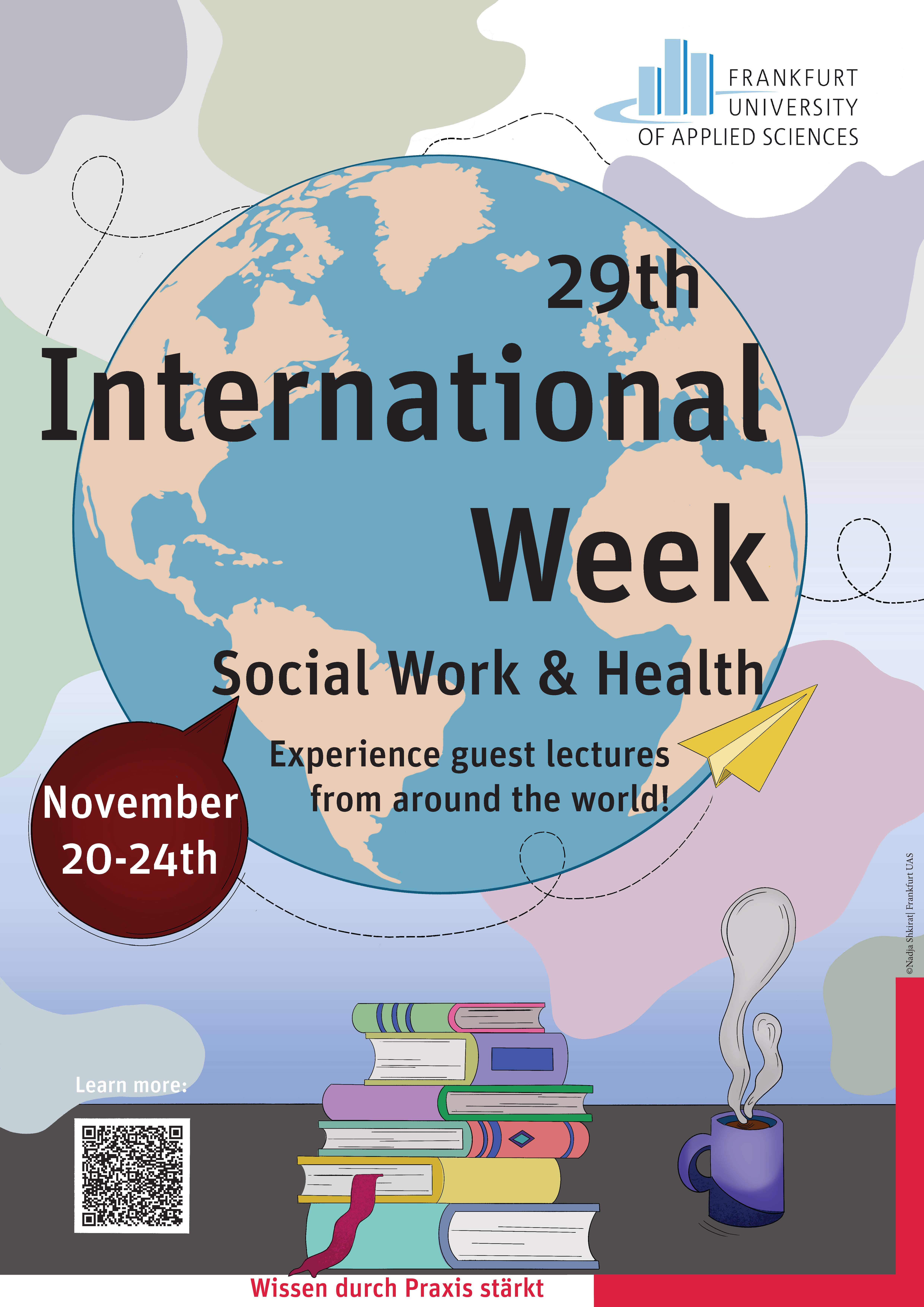
The 29th International Week of Faculty 4: Social Work and Health from November 20-24th, 2023 featured guest speakers from universities in India, Hungary, the Netherlands, Poland, and Slovenia, who shared a wide range of expertise with lecturers and students throughout the week.
The guests were invited to hold lectures in selected courses in several degree programs at the faculty, which enabled many of our students to gain international insights and make global connections right here in Frankfurt. Topics of the lectures included empowerment in an environmental context, feminism and diversity in social work, globalization, children's rights in India, migration in the context of the Russian war in Ukraine, inequalities in health care and creating a dementia-friendly environment, among others. Thank you to all guests and participants for contributing to the success of this week!
About the International Weeks
Every May and November numerous international guests are welcomed at the International Weeks of the Faculty of Social Work and Health of the Frankfurt UAS. They are an important element of the university wide initiative of "Internationalization at Home", which provides students with international perspectives in teaching right here in Frankfurt. The International Week offers the opportunity to students, lecturers and staff to network with our partner universities as well as with practitioners from social and healthcare institutions and learn more about a semester or an internship abroad.
In May, the Faculty of Economics and Law also regularly organizes International Weeks. Through the International Weeks, existing university partnerships are strengthened and opportunities to establish new contacts in teaching and research are created, as well as to promote student exchange. Currently, Frankfurt UAS as a whole maintains partnerships with more than 200 partner universities worldwide.
The "International Day" of the International Office of Frankfurt UAS usually also takes place during the International Week. It consists of an information exhibition on exchange programs and opportunities abroad.
Contact
