
Teaching and Learning Heritage Languages: Multilingualism, Identity, and Innovative methods
Dear Colleagues,
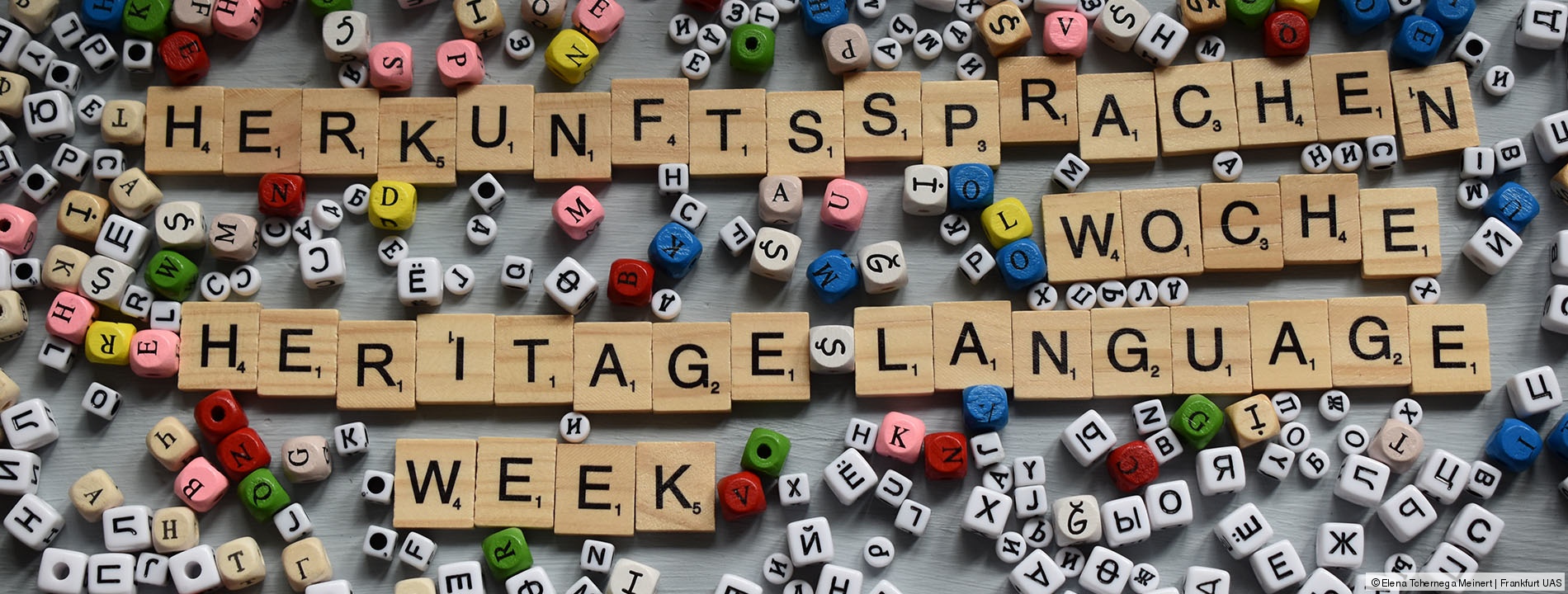
On the occasion of International Mother Language Day, the language centers at Frankfurt University of Applied Sciences and Goethe University cordially invite you to the sixth Heritage Language Week2026. We would like to invite teachers, educators, coordinators, students, and experts in the field of heritage languages alike and join them under the title “Teaching and Learning Heritage Languages: Multilingualism, Identity, and Innovative Methods.”
The aim of the Heritage Language Week is to raise awareness concerning heritage languages. Furthermore, it provides a platform for the exchange of teaching and learning experiences in the field of heritage language teaching at schools and higher-education institutions.
The Heritage Language Week is conducted in the format of a “Good Practice Exchange,” which offers participants the opportunity to present, discuss, and further develop methods and techniques for teaching heritage languages.
The event will take place from February 17 to 19, 2026, in Frankfurt am Main at the Frankfurt University of Applied Sciences.
We look forward to welcoming everyone who works in the field of heritage languages at schools and higher-education institutions. Foreign language teachers are also cordially invited to attend the event.
Participation is free of charge, but registration is required. You will receive a certificate of participation after the event.
Take advantage of this opportunity to exchange ideas with colleagues, gain new inspiration, and shape the future of heritage language teaching together!
Preliminary Program (Subject to Change)
| Time | Program |
09:00–09:45 | Registration Frankfurt UAS, Nibelungenplatz 1, 60318 Frankfurt, Building 1, Lecture Hall 401 |
09:45 - 10:00 | Welcome address: Prof. Dr. Maren Harnack, Vice President for Studies and Teaching, Frankfurt UAS Dr. Sabine Schmidt, Head of the Language Center, Frankfurt UAS Frankfurt UAS, Nibelungenplatz 1, 60318 Frankfurt, Building 1, Lecture Hall 401 |
10:00 - 11:30 | Keynote: Prompts in the Native Language: AI-Supported Material Development for Targeted Differentiation in Heritage Language Teaching Frankfurt UAS, Nibelungenplatz 1, 60318 Frankfurt, Building 1, Lecture Hall 401 |
11:30 - 13:00 | Lunch (at own expense) |
13:00–15:00 | Workshops (parallel sessions) Workshop 1: Slavic Languages: Multilingualism and Intercomprehension in Practice The workshop aims to explore the similarities and differences between Slavic languages from a didactic perspective and to strengthen interlingual skills within the framework of multilingual language education. Participants must have knowledge of at least one Slavic language at any level of proficiency
Workshop 2: “You have consider what it has achieved—there is always something to praise.” Formative assessment and feedback methods in heritage language teaching Motivation to learn is a key issue in heritage language teaching, which means that feedback also plays an important role. How can motivation be maintained and strengthened despite the necessary focus on written language skills and the challenges this entails? In this workshop, we will explore what constitutes constructive feedback in heritage language teaching, how it can be given in small steps in a way that promotes learning, and what options exist for motivational performance assessment and joint analysis of written work.
Workshop 3: Material-Based Writing When Teaching Russian as a Heritage Language This workshop deals with the implementation of the format material-based writing in Russian as a heritage and foreign language courses at state schools in Germany. The focus is on strategies for source analysis, information structuring, and the creation of texts tailored to specific audiences and tasks. Practical examples are used to illustrate possibilities for language support and performance assessment in a multilingual context.
Workshop 4: Vocabulary Work in Heritage Language Teaching: Playful and Motivating Learning The workshopWoring with vocabulary in heritage language teaching: playful and motivating learning" addresses the question of how vocabulary can be taught in an effective, interconnected and fun way. The focus is on the mental lexicon as a cognitive network in which words are not isolated but are connected semantically, phonologically and contextually. |
15:00-15:30 | Coffee break, Building 2, Room 379 |
15:30-18:00 | World Café and Presentation of Results (for all participants) Frankfurt UAS, Nibelungenplatz 1, 60318 Frankfurt, Building 2, Room 462 |
Starting at 18:30 | Joint dinner (at your own expense) & Get in touch Please let us know when registering if you would like to attend the joint dinner |
| Time | Program |
9:00–9:30 | Registration Frankfurt UAS, Nibelungenplatz 1, 60318 Frankfurt, |
9:30–9:45 | Welcome address: Dr. Maria Sulimova, Institute of Slavic Studies, Herder Institute, University of Leipzig / Dr. Elene Tchernega Meinert, Heritage Language Coordinator, Frankfurt UAS Frankfurt UAS, Nibelungenplatz 1, 60318 Frankfurt, Building 1, Lecture Hall 401 |
9:45–11:15 | Keynote: Between Linguistic Variation in a Migration Society and Linguistic norms: Perspectives on Critical Language Preservation Didactics |
11:15–11:45 | Coffee break, Building 2, Room 379 |
11:45–13:15
| Working Groups: Part I (parallel sessions)
Language: Bosnian, Croatian, Montenegrin and Serbian Promoting language awareness and identity-related language reflection in heritage language teaching Adaptation of English as a Foreign Language Materials for BKS Teaching: A Practice-Oriented Presentation
Language: Russian
Presentation of the courses “Adventure in the City of Grammar Masters” and “Traveling with Grammar” for bilingual children
Language: Ukranian Intercultural bridges: a step towards each other to understand Ukranian better Heritage language as the foundation: the potential of multilingualism Learning Ukrainian during project weeks in schools in Hesse (using the example of the “Multilingualism” project)
Language: Turkish Zwischen Chat und Roman: Neue Lesewege für Herkunftssprachen Feedbackprozesse im Herkunftssprachenunterricht: Grundlagen, Herausforderungen, Perspektiven Identitätsentwicklung im Kontext der Herkunftssprache Türkisch
Language: English/German Accent perception in bilingual children acquiring Italian Challenges o teaching Hassaniya as Heritage language in diaspora: Mauritanian families in France and Spain as a case study Hmong Classifiers: Conceptualization of Noun Classifiers in Native Speakers |
13:15–14:45 | Lunch (at your own expense) |
14:45–16:15 | Sections: Part I (parallel sessions) Section I: Methods in Heritage Language Teaching Language: German/English Between Heritage Language and Standard Language: Norms, Goals, and Negotiation Processes in Heritage Language Education Activities in Italian lessons differentiated by level Professionalization of teachers in heritage language teaching: An OER self-study course using the example of the Bulgarian language
Section II: Multilingualism in Everyday Life and Continuous Language Education Language: German/English Curriculum meets diversity: Curricular integration ot heritage languages and the promotion of transcultural skills in foreign language teaching Teachers' competences for plurilingual virtual exchange projects Key data on heritage language teaching - From the ability to return to the education of bicultural people |
16:15 - 16:45 | Coffee break, Building 2, Room 379 |
16:45 - 18:15 | Transitions in multilingualism: Identity and Cultural Experience
Cinzia Tanzella's short stories show how quickly one can live in two cultures at the same time and get wonderfully lost in the process —episodes about linguistic misunderstandings, cultural pitfalls, and surprising moments that arise when one's own heritage language and a new language collide. The stories from Like a Fish Out of Water combine wit, self-irony, and intercultural sensitivity. In her reading for the Heritage Language Week, Cinzia Tanzella will present an excerpt from the collection. |
Starting at 19:00 | Joint dinner (at your own expense) & Get in touch - Restaurant Duble Meze Grill, Rothschildalle 36, 60389 Frankfurt Please let us know when registering if you would like to attend the joint dinner |
| Time | Program |
9:00–9:30 | Registration Frankfurt UAS, Nibelungenplatz 1, 60318 Frankfurt, Builing 1, Lecture Hall 401 |
9:30–11:00 | Keynote: Reading Strategies in Heritage Language Teaching |
11:15-12:15 | Poster session and exhibition of learning materials More Languages — More Together: Experiences from the Multilingual Speaking Competition for Students The Use of Feature Films in Teaching Turkish to Russian-Speaking Students of Various Levels to Improve Their Speaking and Listening Skills English COIL in Russian lessons: Concept, implementation, and experiences from the collaboration between the University of Applied Sciences BFI Vienna and Frankfurt UAS Funtions of code-switching in heritage speakers and other bilinguals |
12:15–13:30 | Lunch (at your own expense) |
13:30–15:30
| Working Groups: Part II (parallel sessions)
Language: Bosnian, Croatian, Montenegrin and Serbian Bosnian, Croatian, Montenegrin and Serbian as the common language of the region of origin: Identity, multilingualism, and didactic practice using the example of the “Zmaj” school Languages and voices of translation: On the role of the implicit author in a comparative reading of H. C. Andersen's The Little Match Girl The role of bilingual children's books in language preservation
Language: Ukranian Ukrainian as a foreign language: Corpus-based analysis of cultural-historical content as a didactic tool Ukrainian lessons in Berlin: Scientifically based and practical approaches as well as empowerment at the German-Ukrainian School Berlin Heritage language as a source of strength in a multilingual environment Immersive strategies for passing on heritage languages in a diasporic context: experiences of the German-Ukrainian cultural and educational organization Oseredok Leipzig e.V.
Languages: English Selective Mutism in Bilingual Children and the role of school The use of dative case by heritage speakers of Russian in the US and Germany Speaking in Images: Making Everyday Multilingualism Visible in Art Education Accent perception in bilingual children acquiring Italian
Sections: Part II (parallel sessions) Section I: Methods in Heritage Language Teaching Language: German Promoting multilingualism digitally: LMS self-study courses for heritage languages – design, implementation, and experiences (Arabic, Russian, Farsi, Serbian, and Kurdish) Cognates in multilingual acquisition: Opportunities and challenges of German-Ukrainian cognates Do you speak Wissenschaft? Parlez-vous universidad? – Multilingual self-study materials for academic language Translanguaging as a Meaning-Making Strategy in the Context of Heritage Language Teaching
Section II: Multilingualism in Everyday Life and Continuous Language Education Language: German Creative German-Russian learning spaces in dialogue between visual and linguistic sign systems Native language "homeopathic globules" in German as a second language courses: application, effects and side effects More languages - more WE: How schools can make multilingualism visible Between two worlds - The power of multilingualism |
15:30-15:45 | Closing discussion |
