

Teaching & Research
- J. Kreß, J. Rau, I. Behr, B. Mohn, H. Hebert, and A. Morgado-Estévez, “Exhaust gas improvement of modern scooters by velocity control,” Control Engineering Practice, vol. 153, 2024. DOI: https://doi.org/10.1016/j.conengprac.2024.106111.
- J. Kreß, J. Rau, H. Hebert, F. Perez-Peña, K. Schmidt, and A. Morgado-Estévez, “Lowcost throttle-by-wire-system architecture for two-wheeler vehicles,” SAE International Journal of Engines, vol. 17, 2024. DOI: https://doi.org/10.4271/03-17-05-0035.
- J. Kreß, J. Rau, H. Hebert, F. Perez-Peña, K. Schmidt, and A. Morgado-Estévez, “Fuel saving effect and performance of velocity control for modern combustion-powered scooters,” Control Engineering Practice, vol. 145, 2024. DOI: https://doi.org/10.1016/j.conengprac.2024.105849.
- J. Kreß, A. Morgado-Estévez, F. Perez-Peña, K. Schmidt, and H. Hebert, “Development of single-axis wheel speed sensor hil test bench for vehicle velocity control,” in Proc. 3rd International Congress on Human-Computer Interaction, Optimization and Robotic Applications (HORA), pp. 1–5, 2021. DOI: https://doi.org/10.1109/HORA52670.2021.9461305.
In Conversation with Prof. Dr. Jannis Kreß
Jannis, what exactly do you do in your collaborative professorship?
On the one hand, I work at IPG Automotive, a spin-off from the Karlsruhe Institute of Technology and global market leader in the field of automotive simulation. I work in product management there and am responsible for two products. IPG Automotive is very research-oriented – both its structures and its mindset are a perfect fit for the university context. On the other hand, I also teach and conduct research at Frankfurt University of Applied Sciences.
How closely are the business-related topics linked to those covered at the university?
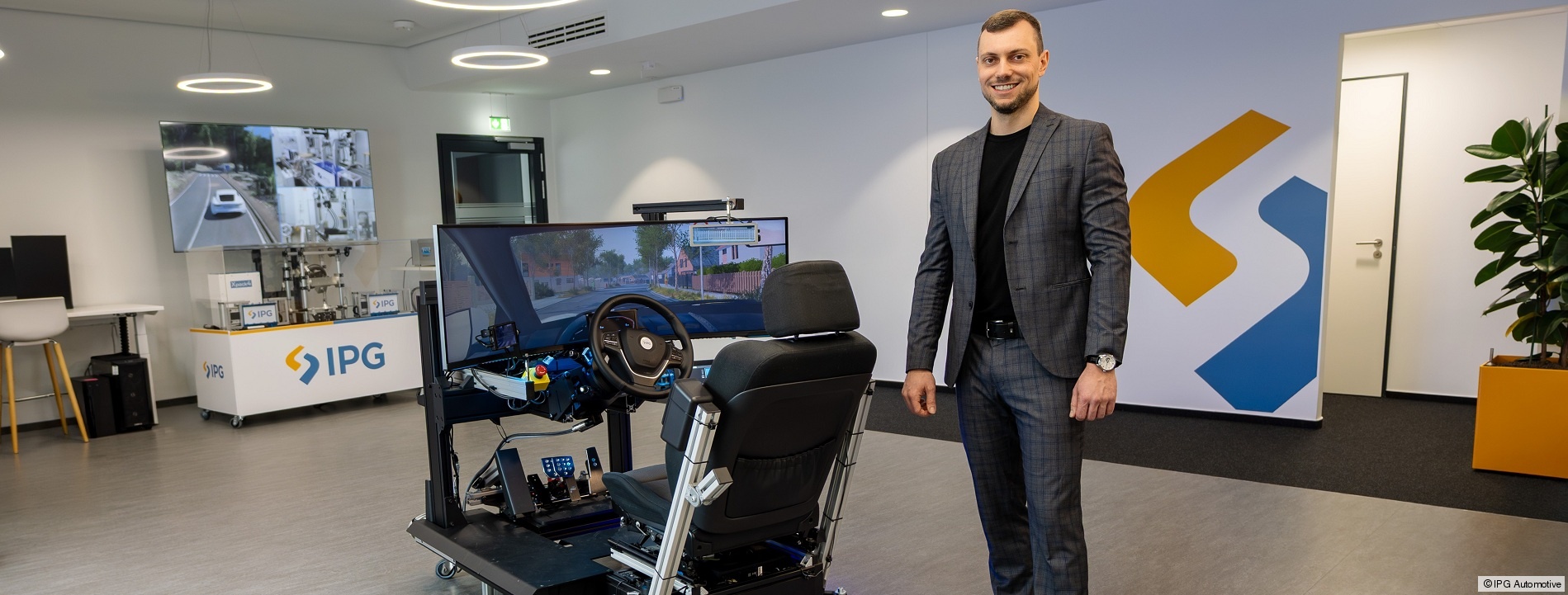
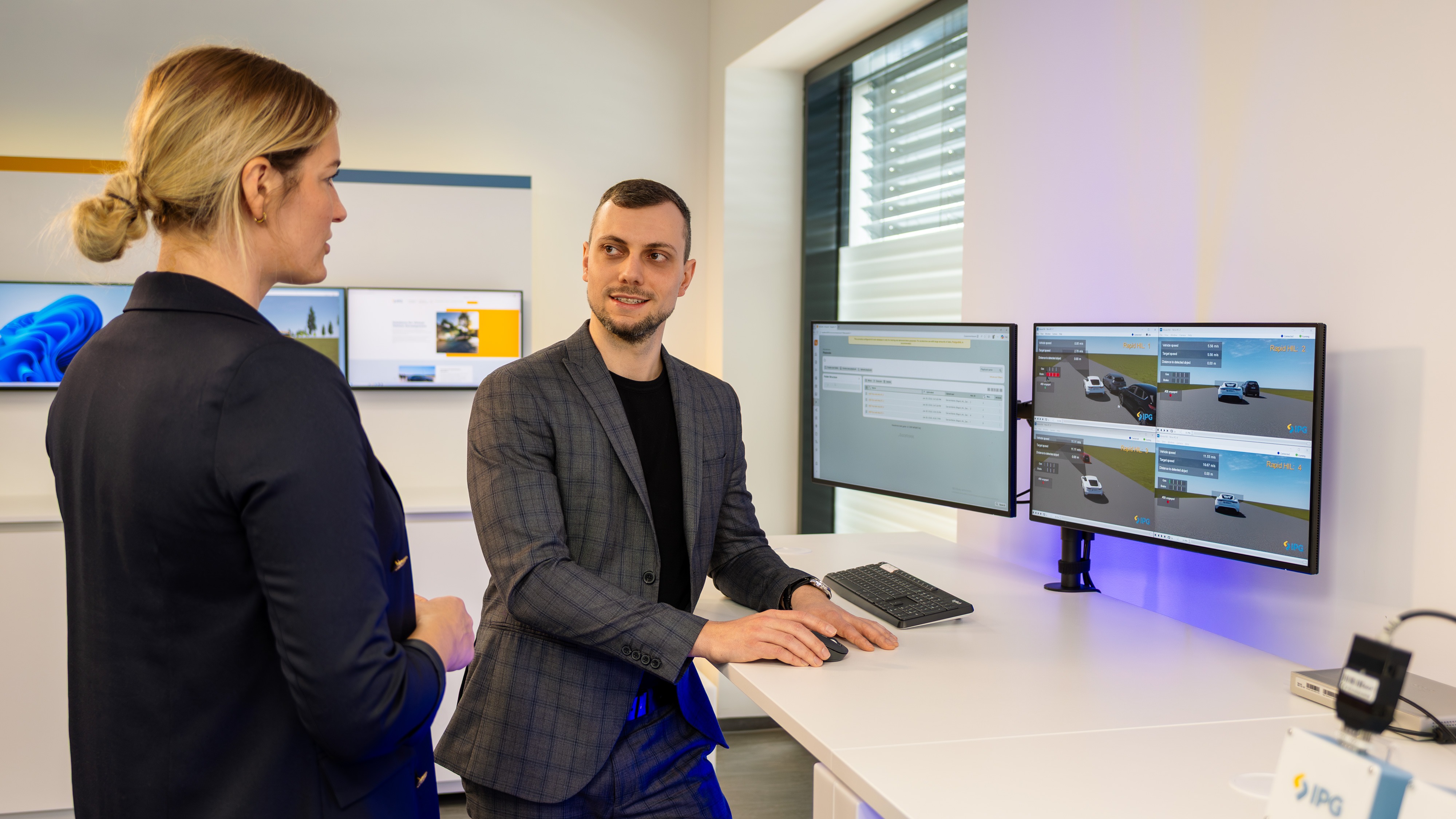
The collaborative professorship is a symbiosis between business and academia. In my teaching, I can incorporate specific topics from industrial practice. At IPG Automotive, for example, we conduct virtual driving tests and develop software and hardware solutions for this purpose. I can introduce these tools to students one-on-one in my courses.
At the same time, knowledge transfer also works in the other direction: methods that I teach at the university are later applied in business and industry. This benefits everyone involved.
Why did you choose this career path?
The path to this career was both a stroke of luck and the result of a long development process. Before joining IPG Automotive, I worked for Continental AG. There, I realised that a purely technical programming job without social interaction was not fulfilling for me. Through my volunteer work and my doctoral studies, I realised how much I enjoy discovering people's potential and supporting their development. It motivates me when people learn new things, gain new perspectives and make informed professional decisions.
The timing was right for my professional development: in 2023, the university was looking for qualified candidates for collaborative professorships as part of the PROFfm programme. The current vice-president supported me in my decision to pursue this format.
What distinguishes a collaborative professorship from a conventional professorship?
Apart from the scope of teaching, there are hardly any differences. I teach and conduct research on a half-time basis, which corresponds to nine hours per week during the semester. However, the expectations in terms of teaching, research and commitment are comparable to those of a full-time professorship. The format therefore requires a high degree of organisation and resilience.
One important difference is surely that you are right in the middle of practical working life, isn't it?
Yes, and that is precisely where the big advantage lies. I can guarantee that my knowledge and methodology are up to date and meet the needs of industry.
What is your everyday life like with two employers?
My everyday life oscillates between clear structure and high dynamism. I have two fixed days a week for university and two for the company. Teaching is not very flexible in terms of time, while the company holds regular meetings that I want to attend. In addition, there is another day for conceptual and organisational tasks. In any case, you have to sharpen the saw, as the saying goes. To do justice to both roles, prioritisation and a good sense of what is essential are crucial.
And you also need understanding from your employer. How does that work for you?
I had the advantage that my position at IPG Automotive was created specifically for the collaborative professorship. I already knew the company and knew that they would be happy to work with me. That's why I actively proposed this format.
What is the feedback from the full-time professors here at the university?
I feel very strong support from my faculty. The dean's office is also fully behind the collaborative professorship. This is also true in light of the fact that the appointment process is just as demanding as for a full professorship.
How do your students benefit from the collaborative professorship?
On the one hand, they benefit on a higher level: they gain insights into industrial structures, requirements and application processes. On the other hand, my practical experience in development flows directly into my teaching – a key aspect, especially for aspiring engineers. In addition, I provide cost-intensive software that students can use both on their personal computers and in the context of final theses in companies. Last but not least, as part of my collaborative professorship, I have set up laboratories where students can learn practical tools and develop functioning solutions.
Does the company also benefit from this model?
Yes. Working students from Frankfurt UAS work at IPG Automotive, we assign theses and have already taken on graduates. In addition, we regularly organise workshops and seminar series at the university in which the company presents itself. Guest lectures complement this exchange.
What are your hopes for the future of the collaborative professorship?
Firstly, I would like to see an established, transparent process that makes it easier to appoint cooperative professors.
Secondly, the model should be further expanded, as it offers numerous advantages for the university.
Thirdly, reliable and continuous funding is crucial in order to be able to offer the cooperative professorship independently of the current economic situation.
Thank you very much for talking to us!
Practice Partner

"The collaborative professorship with Frankfurt University of Applied Sciences is a key component for our company in closely integrating theory and industrial practice. In the joint virtual driving test laboratory with our CarMaker software, we provide practical training for the engineers of tomorrow and work on innovative issues with bachelor's and master's students at an early stage. Guest lectures, workshops and continuous professional exchange further strengthen knowledge transfer and promote sustainable innovation on both sides."
Dr. Pascal Piecha, Global Academic Strategy Manager bei IPG Automotive
Contact Collaborative Professorship

