

Approaching university didactics with a focus on practical application
At our university, students and lecturers come together with diverse interests, backgrounds, and expectations. To meet the needs of all university members, suitable teaching and learning opportunities are required, along with a didactic approach that considers the people, processes, and tasks at a University of Applied Sciences (UAS).
The PROFfm project on university didactics is dedicated to the systematic development of didactic concepts at Frankfurt UAS, with a specific focus on Universities of Applied Sciences.
At the heart of the project is the question of how lecturers at a UAS can be supported in designing their teaching—particularly with regard to practical relevance, interdisciplinarity, and social responsibility. Our focus lies on the development of didactic methods, teaching concepts, formats for reflection and exchange, as well as the promotion of personal competencies.
Based on the strategic goals of the university and in close collaboration with the academic institution ScoPE (School of Personal Development and Education), a subject-specific university didactics is being developed that is both scientifically grounded and practice-oriented.
Teaching understanding and teaching design of professors | December 2025

Recommendations for the design of continuing education and training programmes
Systematically promote collegial teaching and learning cultures
To anchor informal and individualised teaching developments more sustainably, targeted, structured and low-threshold spaces for collegial exchange can be created. Reflection and exchange formats such as peer learning groups, collegial consultations or interdisciplinary exchange forums can be useful for this purpose.
In addition, opportunities to highlight good teaching practice can be created, for example through teaching labs, brown bag formats or internal teaching impulses. This makes it possible to establish a culture of joint reflection, learning and further development of teaching.
Systematising the professionalisation of teachers
For structured and continuous support of the professionalisation of teaching, the development of practical further training courses geared towards specific teaching situations is recommended. These programmes, such as topic-specific micro-workshops or short didactic impulses, should be systematically supplemented by elements of reflection, collegial feedback and cooperative teaching formats.
In addition, it seems sensible to establish a permanent community of practice for the continuous professionalisation process and the transfer between further training and teaching practice.
Strengthening didactic flexibility in a targeted manner
In view of heterogeneous student groups and dynamic conditions, it is necessary to support teachers in developing and implementing teaching concepts that can be adapted to specific situations. The provision of a modular, interdisciplinary toolkit allows for the bundling of variable and tried-and-tested teaching formats.
To promote a professional approach to heterogeneity, concrete examples and strategies for differentiating teaching offerings can also be made systematically accessible.
Anchoring competence orientation in the curriculum
Key competences, or future skills, can be anchored in teaching and examination through visible and binding integration into competence-oriented learning objectives, for example in the areas of data competence, teamwork, critical thinking and communication.
In addition, existing curriculum workshops can also help to strengthen the curricular anchoring of competence orientation. Participatory, research- and practice-oriented teaching formats, such as case studies, research-based and problem-oriented learning, can be promoted.
Consciously designing face-to-face teaching as social added value
The indispensability of face-to-face teaching can be further strengthened by profiling it as a place of social, collaborative and experience-based learning. To this end, it is advisable to use face-to-face formats primarily for interactive, dialogical and community-building learning settings, e.g. through excursions, peer interactions or project-based work.
In addition, the development and design of spatial concepts geared towards exchange, experience and participation can also be helpful. At this point, reference can be made to the initiative of Department 1 at Frankfurt UAS, which is considering incorporating modern learning spaces into the redesign of Building 9.
Facilitate access to continuing education in university teaching
Access to continuing education in university teaching can be facilitated, for example, by expanding micro-learning formats and integrating offerings more strongly into existing work structures through team teaching or collegial observation. In addition, in-house continuing education offerings can be further strengthened, including through HR.
Supporting strategic teaching development in a participatory manner
Teachers can be more closely involved in the further development of the university as an educational institution. The systematic participation of teachers in strategic processes relating to teaching, room design, digitisation and study organisation can be effective in this regard.
In this way, existing teaching expertise can be used to formulate university-specific didactic guidelines, and university didactics can act as a mediating instance between practice, innovation and strategy, building on existing structures such as the AI Task Force, the Quality Image Teaching and the strategic guidelines.
From UAS Didactics to Institution-Specific Didactics | August 2025
At the beginning of the project, the plan was to develop an UAS specific didactic approach for Frankfurt UAS. This was based on the assumption that Universities of Applied Sciences are particularly characterized by practice-oriented features, which might require a distinct higher education didactic framework.
However, recent research findings (Lämmlein, Lutz-Vock, Engelmann, 2025) show that a separate UAS didactic approach has not emerged in the discourse on higher education didactics. Instead, an integrative approach to higher education didactics prevails. Against this backdrop, the focus is now on developing a transformative higher education didactic model. In addition, we will provide a competency framework for teaching.
dghd symposium | March 2025
Key competencies and university didactics: building blocks for transformative university teaching
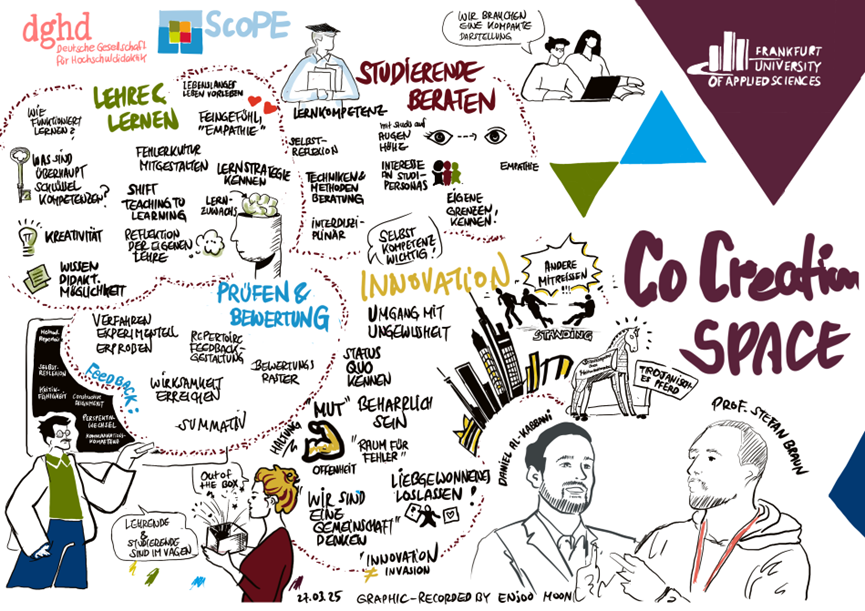
The annual conference of the dghd, organised by ScoPE, brought together university educators, lecturers and doctoral students to present and discuss current research findings on topics such as sustainability, digital skills, democracy education and social responsibility in university teaching. The findings and results will be published in two publications, which will appear in early 2026.
In a participatory co-creation space, a university-specific competence model for teachers was developed that addresses the dimensions of subject-specific, methodological, social and personal competence and links them to the university-wide guidelines of digitalisation, internationality, sustainability and social responsibility. The model is intended to provide teachers with a framework for self-reflection and professionalisation and to contribute to the design of continuing education programmes in university didactics.
ICED Conference in Nairobi | June 2024

In June, Prof. Dr. Stefan Braun, Prof. Dr. Barbara Lämmlein, Prof. Dr. Carola Berneiser, and Hannah Lutz-Vock represented Frankfurt UAS at the ICED Conference at the United States International University–Africa. The theme of the conference was “Advancing Higher Education Ecosystems for Competency Development.”
- "The ecosystem within the ecosystem: the School of Personal Development and Education (ScoPE) as institutionalised crossfaculty think tank and icubator of university innovations" (Prof. Dr. Barbara Lämmlein, Hannah Lutz-Vock)
- "Implementation of a transformative teacher-training program to strengthen the SDG's within the teaching and learning processes" (Prof. Dr. Stefan Braun M.A., Dr. Sabrina Engelmann)
- Piloting a standardised curriculum development process for the design of sustainable and innovative study programs in the context of system accreditation processes using the example of the Social Work degree program at the Frankfurt University of Applied Sciences" (Prof. Dr. Stefan Braun M.A., Prof. Dr. Carola Berneiser).
Annual Conference of the Society for Key Competencies | November 2023
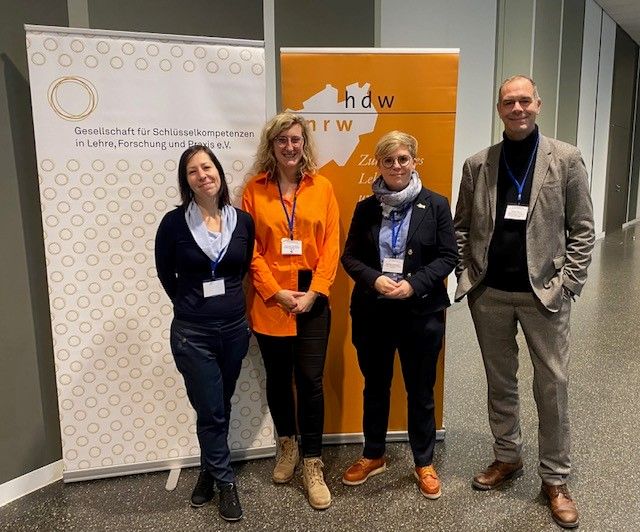
In November 2023, Prof. Dr. Stefan Braun, Prof. Dr. Barbara Lämmlein, Dr. Sabrina Engelmann, and Hannah Lutz-Vock conducted a workshop on “University Teaching of Tomorrow” at the 20th Annual Conference of the Society for Key Competencies. The conference was held under the theme “Key Competencies in Teaching, Research, and Practice: The Transformation of Learning and Teaching – Yesterday, Today & Tomorrow.”
The workshop focused on the question of which competencies university educators need in light of current and future societal challenges. Together with the participants, the team discussed how didactic training and professional development programs must be designed to address the diversity of teaching staff.
The insights gained will contribute to the (further) development of higher education didactic offerings.
Analysis of teaching expertise | 2023
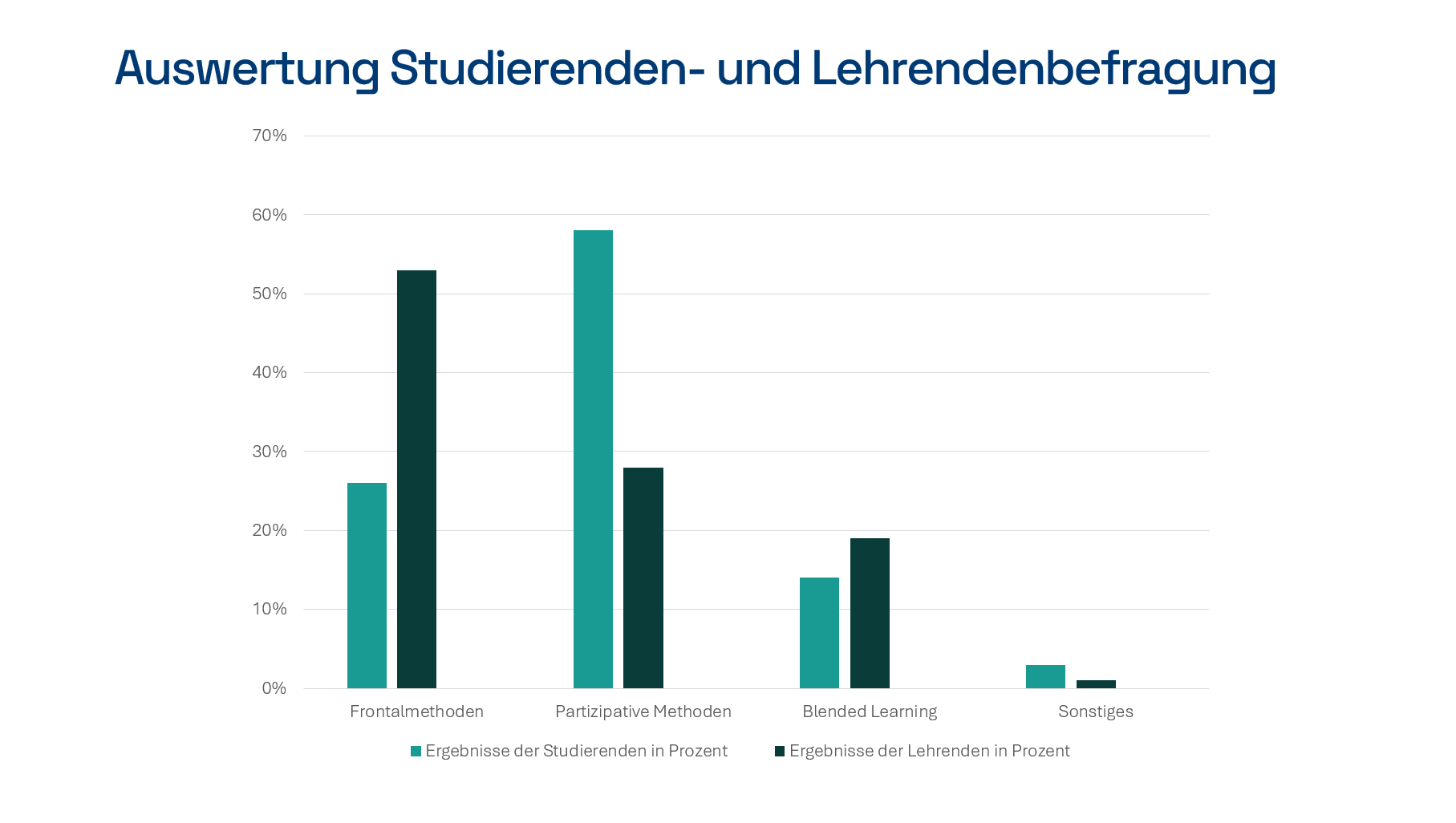
As part of the regular surveys of teachers and students, an analysis of teaching expertise was carried out. The same open-ended question about the teaching methods used was used in each case. The responses collected in free text format were then clustered thematically to reveal patterns and key areas of focus.
Interpretation of the results
The results could indicate a perception phenomenon. Teachers may underestimate their participatory methods and overestimate frontal teaching methods. On the other hand, there could also be such a distortion of perception on the part of the students. This highlights the need for improved self-reflection in teaching practice and targeted university didactic support.
Critical assessment
However, the results must also be viewed critically, as they are not representative of the entire university. On the one hand, a distortion due to social desirability cannot be ruled out; on the other hand, a participation bias must also be taken into account. Accordingly, the results offer rather qualitative insights and indications of perceived focal points without providing a complete picture of the reality of teaching.
Day of Teaching | 29 November 2023

In an inspiring workshop on the Day of Teaching, we took a look into the crystal ball to explore the university of the future. The discussion focused on what future curricula and didactics might look like, and what challenges and opportunities lie ahead.
We visually captured the key topics that emerged during the workshop.
- Buren, V.; Lutz-Vock, H. (2025). Kompetenz- und Persönlichkeitsentwicklung von Studierenden in interdisziplinären Lerngruppen. In: Academic Development Conference, St. Pölten, 2025. https://adc.fhstp.ac.at/programm/beitraege/kompetenz-und-persoenlichkeitsentwicklung-von-studierenden-in-interdisziplinaeren-lerngruppen
- Lämmlein, B.; Lutz-Vock, H., Engelmann, S. (2025) Hochschuldidaktik-Zertifikate im deutschen Bildungswesen – ein Vergleich. Working Paper Nr.35 des Fachbereich 3 Wirtschaft und Recht. Frankfurt University of Applied Sciences. DOI: https://doi.org/10.48718/gjwf-hd94
- Lutz-Vock, H., Tursun, K., Engelmann, S. (2023) Verzahnung von zwei Lehrmethoden. In: Tagungsband zur 12. Tagung Inverted Classroom and beyond mit dem Thema „Agile Didaktik für nachhaltige Bildung“, 16.-17.02.2023, Fachhochschule Graubünden, S. 72-89. (Der Link zu den Ergebnissen liegt bereits auf der Homepage)
- Lutz-Vock, H., Szymanski, K. (2023) Meditation als didaktisches Element in der Hochschullehre. In: Weißenböck, J (Hrsg.): Lernen über den Tellerrand hinaus. Good Practices zu Interdisziplinarität, Internationalisierung und Future Skills. Beiträge zum 11. Tag der Lehre, 30.03.2023, St. Pölten, S. 133-143. (Der Link zu den Ergebnissen liegt bereits auf der Homepage)
- Lutz-Vock, H., Engelmann, S., Lämmlein, B. (2022) Gibt es eine spezifische Didaktik für Hochschulen für angewandte Wissenschaften? TURN Conference ´22 03.-04.11.2022, Kiel.
