

Non-Destructive Testing of Reinforced Materials
This page summarizes earlier research work by Martin O. Steinhauser on non-destructive testing, reinforced composite materials, microstructural characterization, and simulation of fiber-reinforced systems. The central question was how the internal structure of composite materials can be analyzed without destroying the specimen and how this information can be used for modeling and simulation.
In fiber-reinforced materials, macroscopic properties are strongly determined by the distribution, orientation, and interaction of fibers within the matrix. These microstructural features influence stiffness, strength, damage behavior, and failure mechanisms. Non-destructive testing methods are therefore essential when the internal organization of the material must be analyzed while the specimen remains intact.
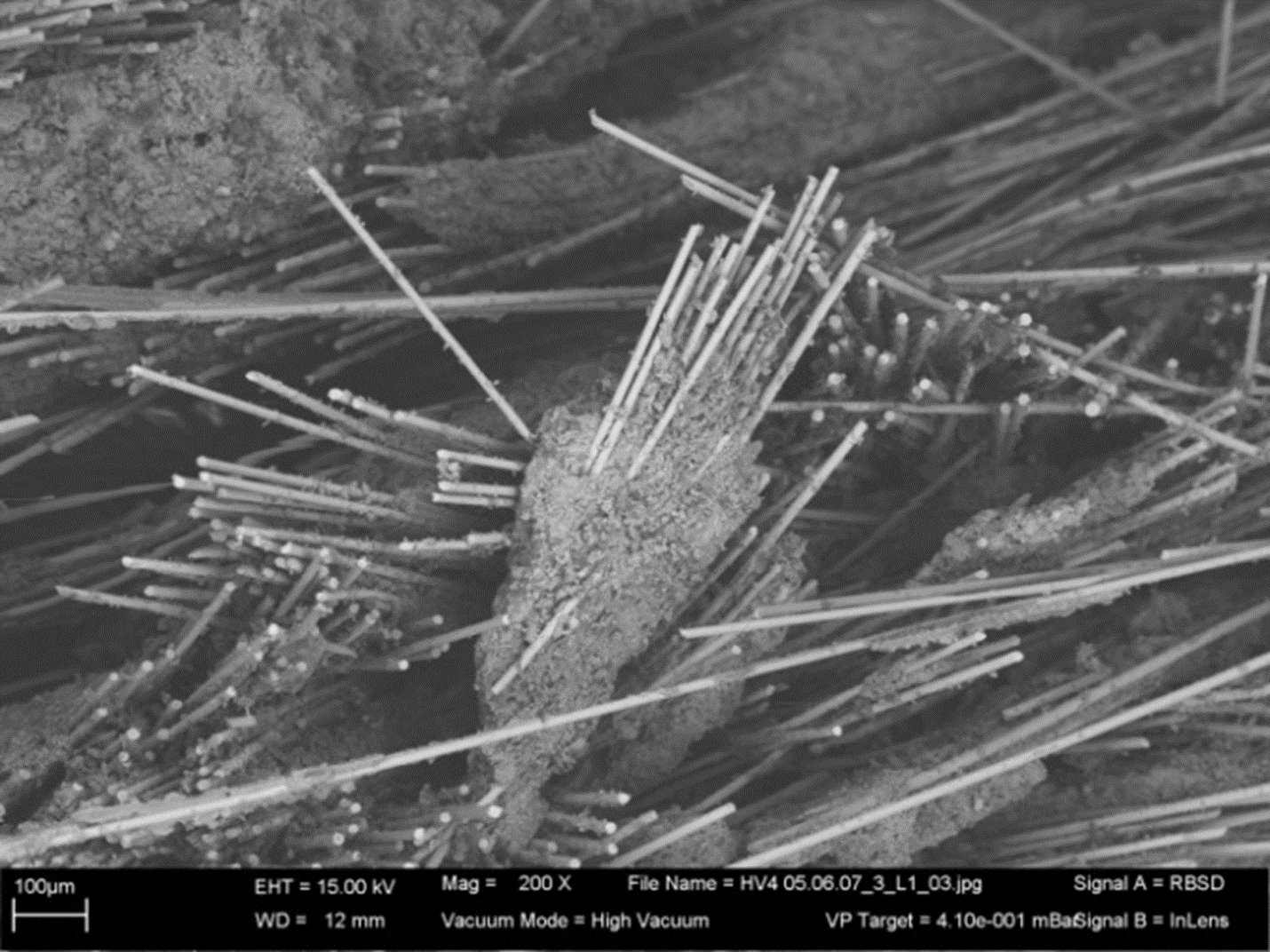
Figure 1 shows an ultrasonic microscopic image of a tensile test specimen reinforced with carbon fibers. Such images provide information about fiber orientation, local heterogeneity, and microstructural organization. Figure 2 shows a higher-resolution view of reinforced material microstructure, illustrating the complexity of the fiber arrangement. The videos on the page illustrate additional three-dimensional visualization and simulation aspects of this research line.
Concept
The concept of this research line was to connect experimental microstructural characterization with computational modeling. Non-destructive imaging methods such as computed tomography, scanning acoustic microscopy, infrared methods, or related techniques provide structural information about the material. Simulation methods can then use this information to study how microstructure influences macroscopic behavior.
This approach is important because composite materials cannot be understood adequately from average material parameters alone. Fiber orientation, local defects, pores, interfaces, and the spatial distribution of reinforcement all affect the mechanical response.

Applications
Applications include fiber-reinforced composites, sheet molding compounds, lightweight materials, protective structures, aerospace and automotive materials, and components exposed to mechanical loading or impact. The work is also relevant for quality control, material design, and the development of simulation methods for heterogeneous materials.
The broader relevance of this earlier work lies in connecting non-destructive experimental characterization with computational materials science. It documents a research line in which imaging, microstructure, mechanics, and simulation are brought together.
Selected Related Publications
The publication listed below documents the experimental characterization and simulation-based interpretation associated with this research line.
Non-destructive characterization of fiber orientation in reinforced SMC as input for simulation based design
K. Schladitz, A. Büter, M. Godehardt, O. Wirjadi, J. Fleckenstein, T. Gerster, U. Hassler, K. Jaschek, M. Maisl, U. Maisl, S. Mohr, U. Netzelmann, T. Potyra, M. O. Steinhauser
Composite Structures 2017, 160, 195-203