

Multiscale Materials Modeling
Multiscale materials modeling connects microscopic structure, mesoscopic organization, and macroscopic material behavior. Observable properties of solids, soft matter, biomembranes, and complex materials often result from interactions across several length and time scales, from atoms and molecules to microstructures and continuum-level response.
This page summarizes earlier research work by Martin O. Steinhauser on multiscale modeling, molecular dynamics, coarse-grained simulation, continuum-based simulation methods, and high-performance scientific computing. The aim of this work was to understand how microscopic structure and local interactions influence effective macroscopic properties such as elasticity, failure, damage evolution, transport, and mechanical response under loading.
A conceptual hierarchy of multiscale materials modeling is shown in Figure 1. It illustrates the connection between models, experiments, microscopic structure, mesoscopic organization, and engineering-scale material behavior. The central problem is that no single numerical method can usually resolve all relevant scales at once. Atomistic simulations provide detailed microscopic information but are limited in system size and accessible time scales. Continuum methods can describe large structures and engineering-scale behavior but require effective material models and constitutive information. Multiscale modeling bridges these levels by combining information from different simulation approaches and, where available, experimental validation.
Figure 2 shows an example of a multiscale simulation setup in which continuum-level descriptions are combined with coarse-grained molecular modeling of a biomembrane system. Such approaches are used to transfer physically meaningful information between different levels of description without reducing the material response to a single scale.
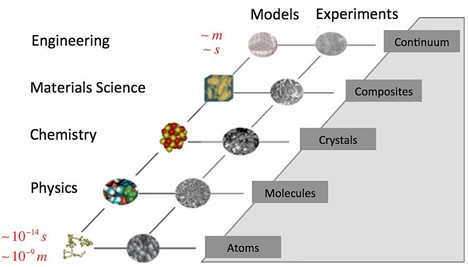
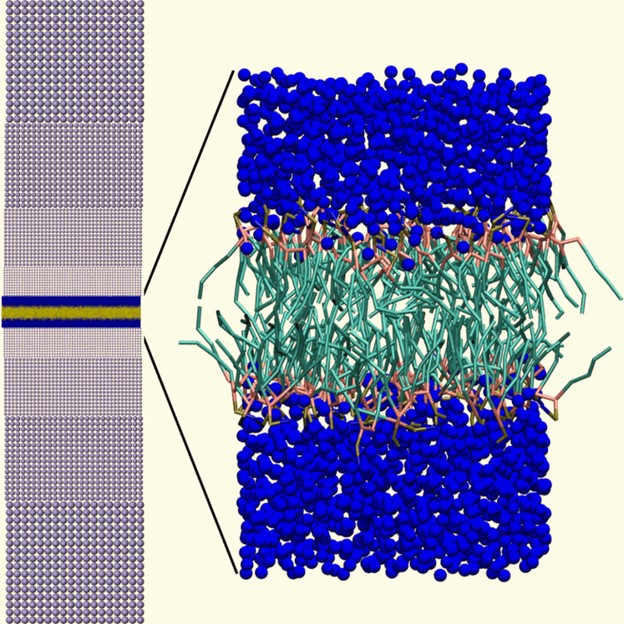
Concept
The concept of multiscale materials modeling is to connect different levels of physical description rather than to replace one level by another. Atomistic and molecular simulations provide detailed information about local interactions and microscopic structure. Mesoscopic models describe collective organization, coarse-grained dynamics, and microstructural evolution. Continuum descriptions represent effective material behavior at larger scales.
The central task is to transfer information between these levels in a controlled and physically meaningful way. This is especially important when material properties depend on microstructure, interfaces, defects, molecular organization, or damage mechanisms that cannot be captured adequately by a single modeling approach.
Applications
Applications include soft matter systems, solid materials, polymer and biomembrane simulations, shock-wave and impact phenomena, microstructure-property relations, materials under mechanical loading, and the development of efficient simulation methods for large-scale scientific computing.
The same conceptual framework is also relevant in biological and materials-science contexts, where upscaling from molecular mechanisms to effective macroscopic behavior is a central problem.
Selected Related Publications
Computational Multiscale Modeling of Fluids and Solids
M.O. Steinhauser
Springer, Berlin, Heidelberg, 4th edition 2026
Multiscale modeling, coarse-graining and shock wave computer simulations in materials science
M.O. Steinhauser
AIMS Materials Science, 2017, 4, 1319-1357
Destruction of cancer cells by laser-induced shockwaves: recent developments in experimental treatments and multiscale computer simulations
M.O. Steinhauser, M. Schmidt
SoftMatter, 2014, 10, 4778–4788